Wednesday, April 6, 2011

Don't Drink The Haterade


I’ve come to the unfortunate conclusion that I’ve become something that modern day society despises. I “hate” that it has come to this and am reluctant to admit it, but I’ve peacefully come to grips with this sad reality.

I am a “hater.”

I used to think that I wasn’t a hater. I’ve always subscribed to the original definition of the term. The common idea that I’ve seen from different definitions of the term that I’ve found (urbandictionary.com, wikipedia.com, wiktionary.com) is consistent with what I originally perceived it to mean. For the most part, a “hater” originally described someone who is so envious of another person that he or she is bent on preventing said person’s further success. A hater cannot stand to see that person do well and usually has no good reason to dislike or antagonize said person. I think most people would agree that such a person has issues. Most of us have better things to do than to be obsessed with someone else’s demise.

Even this definition of the term “hater” has become very popular. Many catch phrases and songs have been dedicated to “haters.” “Don’t be a hater.” “Let your haters be your motivators.” “Don’t hate, congratulate.” “Hi, Hater.” People have even come to measure their success by the amount of “haters” they have. One of my favorite comedians, Katt Williams has this to say about “haters”:

“Ladies, if you got 14 women hatin’ on you, you need to figure out how to get to 16 before the summer get here! Fellas, if you got 20 haters, you need 40 of them…!”

While I can agree that success inevitably comes with people who will be envious or jealous of you, there is a part of me that can’t really take this mindset seriously. I mean, do people really have that many enemies? That many “haters”? The way some people describe having “haters” sounds a lot like how people describe having roaches, rats, or any other kind of pest.

Okay, I’ve veered away from my main point, but I had to throw that out there. Again, if we go with the original meaning of the word, I am not a “hater.” But oh, how times (and definitions of words) have changed. If you consider the context in which the word “hater” is used in modern slang, movies, and music, a “hater” is now anyone who disagrees with you, dislikes your work, or even has an opinion that is contrary to what is popular, regardless of the legitimacy of your reasons. As you can probably imagine by now, I feel that this word is horribly misused and overused.

For example: I respect Kobe Bryant as a basketball player. I think he is arguably the best basketball player in the NBA right now and probably will be for quite some time. However, I do not like him because of his arrogance. The man entered the NBA draft out of High School and told the team that drafted him that he would no play for them and demanded to be traded. This just reeks of arrogance and ingratitude to me. However, if I so much as say that I don’t like Kobe Bryant, I would barely be able to shape my mouth to begin to state my case as to why before someone would label me as a “hater.” Another example, I dislike Soulja Boy’s music. I admit, the first few dozen times I heard “Crank Dat Soulja Boy” I danced right along with everyone else. However, after that got old and I actually paid attention to his lyrics, I felt that they lacked the substance I was looking for that would make me want to even hear his songs on the radio, let alone spend money on him. But again, let me even hint at the fact that I don’t like him, and someone will label me a “hater.”

Yet another example, I was having a conversation with a female friend of mine about men carrying “man-purses.” (I have to stop and say that I seriously question the masculinity of anything that has to have the prefix “man-“ added to it.) I respectfully stated that I don’t agree with men wearing “man-purses” or “man-bags”, and that you wouldn’t catch me wearing one. She quickly responded, saying “You can’t hate!!! Everyone has their own style.” “How am I hating? I’m just stating my opinion?” I asked. Can I not have my own opinion? Is it not ok to disagree with someone or something? Am I forever doomed to have to conform to what is popular?

In this American society where everyone believes they’re entitled to so much (there goes yet another word I’ve come to hate: “entitlement,” but that’s another blog for another day. Oh, look! I said “hate” again. I’m such a hater), one would think I’d be entitled to have and state my own opinion, but I guess that’s too much to ask nowadays. If you’re not down with what’s popular, if you don’t like what everybody else likes, you’re a “hater.” Don’t dare play “Devil’s Advocate” or offer constructive criticism. You might be considered king of the haters for going that far. Considering all of this, I decided to go ahead and label myself a “hater.” I am a “hater-hater”, if that makes any sense. I’m hatin’ on the whole concept of “hatin’.” I encourage anyone reading this to not be afraid of being called a “hater.” Don’t drink the haterade that society is serving you and think that you have give up your ability to think independently and decide for yourself if you like something or not. To paraphrase Common, a hip-hop artist that I highly respect, “If you don’t like it, you don’t like it. That don’t mean that you’re hatin’.”

Friday, April 1, 2011

"You's a FOOL."

Ah, yes. April 1, 2011. “April Fool’s Day,” once again. Being the inquisitive person that I am, I thought about the word “fool,” since it apparently goes along with today’s theme. Myself included, we often throw around this word very loosely. I figured it would do us all some good to really take time out to gain an accurate understanding of what a “fool” is and what it means to be one.

Whenever I come across a new word or a word I otherwise am not sure that I have an understanding of, I head over to dictionary.com on my handy-dandy iPhone. What a concept! Don’t know what a word means? Look it up! *END SARCASM* I feel this is important because countless words have strayed from their original meaning, so far that many of us often don’t realize what we’re really saying when we use particular words. The word “fool” has a few meanings, but the first definition listed is this:

-noun

1. A silly or stupid person; a person who lacks judgment or sense.


I also decided to consult God’s word –The Bible– (there’s another worthwhile concept) regarding what it means to be a fool. The word “fool” and its many derivatives appear countless times throughout the Bible, but the best place to find the characteristics of foolery can be found in the book of Proverbs. There are many verses that touch on this subject, but here are the ones that stood out to me.

A “fool”:


– Despises wisdom and instruction. (Proverbs 1:7)

– Is complacent. (Proverbs 1:32)

– Talks (chatters) too much. (Proverbs 10:8, 10)

– Lies and slanders. (Proverbs 10:18)

– Will eventually DIE from lack of sense. (Proverbs 10:21)

– Finds pleasure in wickedness. (Proverbs 10:23)

– Does not listen to advice. (Proverbs 12:15)

– Shows annoyance at once. (Proverbs 12:16)

– Detests turning from evil. (Proverbs 13:19)

– Tears down her own house. (Proverbs 14:1) *Scripture specifically addresses women, but I’m pretty sure many a male fool has done the same.*

– Is prideful. (Proverbs 14:3)

– Mocks at making amends for sin. (Proverbs 14:9)

– Is hotheaded, yet feels secure. (Proverbs 14:16)

– Is quick-tempered. (Proverbs 14:17)

– Has wandering eyes. (Proverbs 17:24)

– Delights in airing his/her own opinions. (Proverbs 18:2)

– Is quick to quarrel. (Proverbs 19:29)

– Is wise in his/her own eyes. (Proverbs 26:5)

– Repeats folly. (Proverbs 26:11)

– Gives full vent to rage. (Proverbs 29:11)

– Speaks in haste. (Proverbs 29:20)

– Exalts himself. (Proverbs 30:32)


Despite the fact that this list is not at all exhaustive, I’m pretty sure everyone has fallen or still does fall under at least one of these characteristics, myself included. This is very convicting, to say the least. I implore anyone who is reading this to take these scriptures to heart. Ask yourself: Are my ways foolish? We are very foolish indeed if we refuse to acknowledge and address the foolery in our lives when pointed out to us.

Thursday, March 24, 2011

"He Says/She Says" co-starring @CityGirlsWorld

Here's the story: Late last year, I tweeted about my blog "Chick Flicks & Salsa" and shared it with some of my favorite relationship bloggers on Twitter. In it, I hint at the fact that I believe it is the man who should be the leader in any relationship. One of the bloggers that I sent this to, Jess of @CityGirlsWorld, respectfully disagreed, saying that it should be "70/30 or 60/40, man/woman" (paraphrasing). This lead to a friendly Twitter debate on the subject, after which we both agreed that the topic deserved mere attention than we would be able to give it with Twitter's 140 character per post limit. Jess suggested that we collaborate and do a "He Said, She Said" blog together, where we both give our opinions on the subject. The following is our 3 part series, all featured on Jess and Christie's site, "City Girls' World." Enjoy :-)


***Jess & Christie have since closed their website.  Fortunately, I pdf'd the articles prior to that and was able to salvage them.  Below are the articles in text form.  To my wonderful ladies of the late "City Girls World", if you ever read this again, thank you so much for our pleasant and colorful interactions.  I wish y'all the best!!!***


He Says/She Says with SmooveSalsero! Part 1: I Love You?
Posted by Christie - 20/01/11 at 08:01 am
After a feisty tweet-off about dating rules with one of our favorite readers, Myron (aka SmooveSalsero), we thought it'd be fun to pin him down about some of our favorite dating "issues" and see how our opinions compared. Are men and women really that different? Do we *maybe* see things the same way? Wait—don't answer that!! 
But instead of viewing men as the Coke, and women as the Pepsi, maybe our he said/she said will out us all as Dr. Pepper? 
As such, we bring you.... our newest he says/she says!

1. Who should say "I Love You" first? Is there a timeline/deadline where it has to be said?

He says: I know many women would feel like they'd be waiting forever and half an eternity for this to happen with certain guys, but I think it should be the man who says "I love you" first. A younger, less mature version of myself would disagree with what I am about to say, but I am a firm believer that it should be the man who initiates and sets the tone of a relationship. Why, you ask? Consider these things: even the most independent, liberal, "I-don't-need-a-man" type of woman wants to feel desired and pursued; that the man that is with her chose her above any other woman. Even the laziest, timid, wishy-washy, unassertive man will go after something if he really wants it. Ladies, you would rather have a guy that really wants you as opposed to a guy that just kinda wants you or isn't sure if he wants you, right? If you have to say "I love you" first, he either isn't sure he that he does, or he doesn't love/want you enough.
Now, here's where it gets complicated. If you tell a guy you love him first, he may stick around and tell you what you want to hear. Why would he do this? Here's an analogy that may help. I prefer Pepsi over Coke (yet, I'm from the South... go figure). I don't dislike Coke, but if I have my choice and I really want a soda, I'm going to get a Pepsi However, if you just happen to offer me a free Coke, I'm probably not going to turn it down. Now, if you give me Diet Coke, which I really can't stand the taste of I'm probably going to turn you down, unless I'm just dying of thirst. Get the picture? If something free just falls into someone's lap, said person is not going to turn it down unless he or she truly does not like whatever it is. Same as with a relationship: unless the guy is one of the more honorable of the gender or he just finds you completely repulsive, he is going to let you hang around instead of telling you he really doesn't like you like that, because having you around is better than not having a girlfriend.
As far as a timeline or deadline, I don't think you can put a rule or guideline on it. You have to know that for yourself.  How long is too long for you? It also depends on the other person. Whether you're a woman waiting on the guy to say it first or you're the guy and you're waiting for her to reciprocate, you have to decide for yourself if that person is worth it. You have to know your own worth first, and from there you can determine if your time is being wasted or not.
Christie Says: SmooveSalsero makes really good points...and now I am also craving a soda (I also like Pepsi!). I think I've mostly had relationships where I do find that the man says 'I love you" first...to me, that has signified his commitment to a serious relationship that is definitely going somewhere.
However, I do think that there is something to be said for girl power, and for cutting through the crap. When I was in my early 20's, I often felt I was game playing rather than really committing. I had a set of arbitrary rules in my mind, and I would hang onto someone longer than I should have because I was following the rulebook and waiting on him to act like the plot of some sort of 1940's movie. As I get older, I realize that I don't have the time or patience for game playing or waiting around... so, I often just cut to the chase. Granted, this may not mean saying "I love you" first, but it does mean that if I don't feel it, or if my gut twinges and says "this doesn't feel quite right" then I move on.
I do this because I whole-heartedly believe that you know. In a good relationship you know if he loves you and you love him, regardless if the words have been spoken or not. It's shown in every small way—how you talk to each other, how you take of each other, even with how you look at each other (with that special sparkle in your eye! Versus, you know, a creepy stare). And if you feel after a certain period of time that you don't know, or you feel like you need to say it in order to find out, then you are in denial about his feelings and probably just kidding yourself.  I say this knowing it is harsh, but I honestly believe that it is a basic truth.
As to the timeline—whenever it feels right. Say it. Don't be afraid to shout it from the rooftops. If you feel that certain, then he does too.

He Says/She Says Part II: Exclusivity
Posted by Christie - 24/02/11 at 10:02 am
The second in our three part series with SmooveSalsero!
Does exclusivity need to be a conversation? (aka the "where is this going?" conversation). Remember high school when we'd just hold hands and assume we're boyfriend and girlfriend? Why can't it be like that? (or can it?!)
He Says: I wish it were as simple as it was back in High School. Then again; for me, it wasn't that simple. I was painfully shy and insecure back then, so I never approached women. Ok, I digress; I'll refrain from any further venting about my romantic adventures (or lack thereof) in High School.
Unfortunately for us all, it's not that simple, and that's exactly why I believe exclusivity needs to be a
conversation. Assumptions often lead to embarrassment and the wasting of one's time and energy. This is doubly true for relationships. I think the "where is this going?" conversation definitely needs to happen. You don't just hop in your car and ride, without knowing where you're going, do you? Likewise, if you don't have "the talk" with the person in question, you may think that you're already halfway to the other side of the country when he or she thinks you haven't even left the driveway.
I don't think that the initiator of said conversation needs to be the man. It's not quite as serious as the commitment of saying "I love you." I mean, I think we all deserve to have clarity/closure in a situation, regardless of gender. However, I will say this: if you are a woman and you are considering initiating the "where is this going?" conversation, I dare say that if you had to ask, you probably know the answer already, and it's probably not the one you were looking for. There are plenty of exceptions that keep this from being a rule, but for the most part if you as a woman are having to start this conversation, either it isn't where you think it should be or want it to be, or he isn't doing a very good job of leading or making things clear to you.
Another reason why I think exclusivity needs to be a conversation is that each person needs to know what the other person expects. It's like reading the fine print on a contract: you both need to know what you're getting into. It's not fair to expect something from someone else when they don't know that you're expecting it. How exclusive (or not) you want to be, where you want the relationship to go, how often you want to see each other, your love languages, your pet peeves, what you will and won't stand for; all that needs to be discussed up front ifa relationship is to last.

She Says: There was a time I specialized in European men (living in Europe made that easy) and let me tell you how things work over there. You meet, you hook up, you hang out, you hook up again, and then he installs a toothbrush and razor in your bathroom. In week 2, he'll invite you to meet his parents. I recall one particular phone call with a guy I had been dating for about a week. We were talking about our international connections (relatives living abroad, etc) when he casually mentioned that he had an American girlfriend. I gasped. What kind of a-hole would date a girl, profess his adoration for her, leave a toothbrush at her place all the while he already has a girlfriend?! ! Then it hit me. It was me. I was the girlfriend. But how could it have happened so fast? And without me knowing (or giving consent)?! What kind of strange universe had I entered?
But we don't live in Europe. We don't have their affordable wine, their fresh bread, or their commitment-ready men. No.
Over here in the US of A, we have certain rules. And one of them is that there has to be some sort of established mutual agreement before a relationship becomes serious (read: monogamous).
I agree with Smoove when he suggests that the answer is probably already in your gut. In my experience, when I (or he) felt the need to spell it out, it was because one ofus was not fully on board. By contrast, in the serious relationships I've had, the transition from dating to boyfriend/girlfriend was a gradual but plainly obvious process. If you are talking about plans for next month, if you are telling each other how much you lace each other, if you're meeting each other's friends, if you are making jokes about other women/men in your life (as in, "don't worry, all the girls at my office are already married"), well then you can see the writing on the wall. And one day soon enough, someone will drop the word "boyfriend" into a conversation. It may not even be one of you.  Meddling friends can be really helpful in this way! And voila, you'll know. Just hang tight and pay attention.

He Says/She Says Part 3: Can She Make the First Move?
Posted by Guest Author - 24/03/11 at 10:03 am
Part 3 of our he says/she says series with SmooveSalsero! Is it ever awesome for a girl to make the first move? If so, how should she do it?
He Says:
This may seem slightly contrary to my answer in the previous article on who should say "I love you" first, but I do think it is awesome for the girl to make the first move. The difference between being the first to make a move and the first to say "I Love You" is this: with the former, you are just letting the guy know you are interested. With the latter, you are pushing the relationship (if it can even be called such at that point) into a place that the other person may not be ready for or even want to enter into.
To me, for a woman to make the first move by asking me out, it is indeed flattering and it makes it obvious to me that she's interested, or at least interested in getting to know me, and that's enough for me to consider, or more seriously consider, the possibility of the same with her. How should she do it? I'll point you to a great article byfellow blogger and tweeter, Steven J. Dixon:
There's hardly anything in this article that I can disagree with Basically, if you do ask a guy out, it's really for the sole purpose of getting him to take notice of you and let him know that you're available. After that, it's best to leave the ball in his court. Give him the "green light," so to speak, but he has to make the choice of whether to go straight, or instead turn left/right/u-turn. Anything past that, and you're taking control of the relationship. As long as you're in a relationship with that guy, you'll find it hard to ever get him to step up and take charge of anything because you set that tone from the beginning, and you will eventually resent him for that. You have to let him know you want to be chased (and caught), but no more than that. Otherwise, he will never truly pursue you because he feels has no need to. You have jumped into his lap and given him the impression that you're not going anywhere.
She Says:
Jess here, speaking for both of us. We are big proponents of women making the first move. Now, notice I don't say we enjoy/prefer/believe in it. It's just a question of practicality.
All women know the typical Friday night bar scene. There you are scoping the crowd, looking for that one gentleman in the crowd that may be appealing —a diamond in the rough. But just as you spot him and establish eye contact, BAM, a slimy dude and his entourage jump in. While you're squirming under his lame attempt at conversation (or worse you let him buy you a drink and now you feel obliged to stay and chat), Mr. Adorable has looked away with a discouraged sigh.
What's a gal to do? Rather than lose out on great guys night after night, you have to take matters into your own hands. After all, the kind of guy you're seeking is maybe not the one that slithers in with a slimy pick-up line, right? So, Christie and I advise that if you see something you like, you might as well walk up and take it (or, errr, talk to it, as the case may be).
Now admittedly, Christie is an opener and I am a better closer. But we have employed various techniques at making the first move that don't require us to make much of a move at all. Like Smoove says, you still want the guy to be doing the pursuing. We just help out by letting him know that his advances will be welcome.
Game on.
Round 1? Eye contact. Get his attention. If he doesn't walk over right away, add a flirty smile for good measure. This usually will do the trick.
Round 2? If the guy is making eye contact and smiling back but still not walking over, it may be that he's young, inexperienced, shy, or just dim. Either way, in this case we recommend adding the "wave over." Use one hand, smile, and make the motion of "come here." You'd be amazed at how effective this can be. So simple, even the shiest girl can pull it off and yet it's a move that oozes confidence and sex appeal You can also use the wave over in round one if you are looking to expedite the process.
Round 3? There are those rare occasions where you just want to make a bold statement and then move along. For those instances, you need the "face grab" — a patented move whereby you walk up to the gentleman, place your hands on the sides of his face, lean in, and smack one on him (we strongly recommend doing a shot beforehand). Be warned that this is a powerful maneuver and in at least one instance caused the subject to come running out of the bar screaming and begging for Christie's phone number. For that reason and many others, we will probably never be able to visit Rome again. But that is a tale for another time...

Thursday, March 10, 2011

"DON'T JUDGE ME!!! God knows my heart..."

"Don't judge me!"

No doubt, you've probably heard this phrase and other derivatives of it before. Everybody knows you're not supposed to judge people. "Don't judge a book by its cover", we say. (I know it's not meant to be literal; but seriously, when's the last time you willfully continued to read a book after deciding that you didn't like the cover? Don't worry, I'll wait...)

This popular concept originated from the Bible, in Matthew 7:1-5. Pastor Rodney Finch expressed during a sermon that this is such a popular scripture (or rather, the message from the scripture is popular) that even non-Christians and Atheists know it. Everyone is so quick to blurt out "don't judge me!" It's such a well-known concept that it has even become a popular hash-tag or "trending topic" on twitter - #dontjudgeme. People tag their tweets with this whenever they tweet about something that someone may give them the "side-eye" for, or otherwise question their actions. "I just bought Justin Bieber's new album! #dontjudgeme." "I just ate a whole carton of cookie-dough ice cream. #dontjudgeme." "I just killed my wife and kids. #dontjudgeme." Ok, I was being extra sarcastic on that last one, but dare I say it may just go that far one day. In my opinion, I think the phrase "don't judge me" is ridiculously over-used and misused. It's being used as a defense mechanism for people who want to do whatever they want with no accountability for their actions. For those of us who are "Christians" (using that term lightly here), we want to live our lives the way we want without anyone challenging us on our sin.

This scripture, contrary to popular belief, is not forbidding judging. In fact, there are many other scriptures in the Bible where we are told that we should judge; in some cases, we are even commanded to judge. Here are just a few:

1 Corinthians 6:1-6 The Lord's people will judge the world, and even judge angels!

1 John 4:1-3 We are to judge whether or not a spirit is from God or not.

Romans 16:17 We have to judge whether or not someone is causing divisions in the Church, because we are commanded not to associate with them.

1 Corinthians 5:9-13 We are commanded to expel so-called believers from the Church if they claim to be a brother or sister, yet still live in sin. We are to judge those within the Church.

It would not come as any surprise to me if anyone reading this tries to pull the age-old "the Bible has contradictions" card on this. For this subject and any other subject where the Bible allegedly has a "contradiction," I implore you to dig deeper. As we are about to do so now, you'll see that a deeper study of a "contradiction" will reveal that there is not one at all. If you look up the word "judge" in the dictionary, or --for you aspiring Bible-scholars out there-- if you look up the root Greek word krinō, you'll see that the word judge has many uses. This should be obvious after looking at the various scriptures that the word "judge" is used in, but the meaning changes depending on the context. The only method of judging that is really outlawed in the Bible is condemnation, in which a sentence or punishment is carried out. Only legal authorities and God can do that (hence, the phrase "Only GOD can judge me"). Unfortunately, people assume this is the case for all forms of judgement, thinking that only God can make a discernment or an identification of one's actions.

By now, you're probably wondering, "what does Matthew 7:1-5 really say?" This scripture is not speaking against identifying faults and sins, but against harsh and hypocritical judging. It simply states that if you do judge, the same degree of judgement that you use will be returned to you. Meaning, if you judge someone harshly, with disrespect and malice, you will be judged the same. Likewise, if you judge someone gently, with respect and genuine concern for the person's well being, you will be judged the same. Also, we should not judge someone on something that we also are guilty of, especially if we are even more guilty of it than the person we judge. Many commentaries on this passage also state that a fault-finding spirit is being addressed here. There is a difference between calling out sin when it is noticed and just going around sniffing for sin in people's lives. We are all commanded as brothers and sisters in Christ to call out each others' sin for the purpose of calling each other higher and get each other to heaven, but constantly looking for sin and nit-picking at each others' faults is very destructive.

Another scripture that is often misused in similar fashion is John 8:1-11. The phrase that is coined from this passage is "let he who is without sin cast the first stone" (verse 7). People mistakenly interpret this as meaning that only those who are without sin themselves can challenge others on their sin. Conveniently for some, this would, of course, mean that no one can call anyone out on their sin. However, this was not Jesus' intent. Again, if we look closely at the context of the situation, we get a more accurate meaning. In those times, the punishment for adultery was to be stoned to death. If you look at the anatomy of a stoning, either the judge presiding over a case or the witnesses of the crime was allowed to throw the first stone during the execution. In verse 7 of this passage, Jesus is referring to the actual execution of the adulteress' death sentence, not the identification of her sin. Both the Pharisees (verses 4-5) and Jesus (verse 11) identify her sin. In regards to throwing the first stone, Jesus is turning the tradition of the execution against the Pharisees, stating that those who have not sinned should be the first to carry out her execution. Clearly, Jesus is not speaking against the identification of sin. If only those without sin could call another person higher (clearly, this was not the Pharisees' intent) by correcting the sin of another, no one would be able to do so, and we'd all be hell-bound.

So, we've made it clear that the Bible does not speak against challenging and correcting each others' sin, so long as we are not judging harshly or digging for the negative. However, I know there are many who, upon being corrected, will use an excuse that I love (to hate): "Well, God knows my heart." This is indeed true, as shown in many scriptures (Psalm 44:20-21, Luke 16:14-15 and Acts 15:8 are just a few). However, just as is shown in these scriptures, this means that God knows both the good and the bad in our hearts. The impression I get from most who use this excuse when challenged on their lives is that they are implying that whatever is showing in their appearance or actions is not revealing the true good that is within their hearts. Granted, we all mess up and will fall short of God's glory from time to time. I get that. None of us are perfect or "without sin." However, there is a difference between a mistake and a habit; between sinning and living in sin. To paraphrase a good friend of mine, you must ask yourself if your mistake is really just a mistake, or if it is the norm. Proverbs 27:19 reveals that your life reflects what is really in your heart. What you consistently do, think, and say shows what's really in your heart. 1 Timothy 4:15-16 also states that if you really are devoting yourself to something (aka if it is really in your heart), it will be evident to all. You won't have to say that "God knows your heart." Yes, he does. And that's usually not a good thing for us if we're having to make excuses for ourselves as to why we're not living the way we should.

As we've seen, many scriptures get twisted and taken out of context. Some innocently, some with selfish or prideful intent. Either way, we must be careful not to misuse God's word. In regards to these particular scriptures, we must be mature in how we correct others and take correction ourselves. Those of us doing the correcting must be sure to do so out of love and respect, not just trying to dig for dirt in our brothers and sisters' lives. We must also be sure not to correct when we are guilty of the same sins. On the other end, those of us who are being corrected must learn to let our defenses down and realize that those who are correcting us are doing so out of love for God and us. In my humble opinion, no true believer should ever use "don't judge me" or "well, God knows my heart" as a rebuttal to correction from another. We should be mature and humble enough to take it to heart and repent where necessary.

Thursday, March 3, 2011

Cold-Blooded Emotions

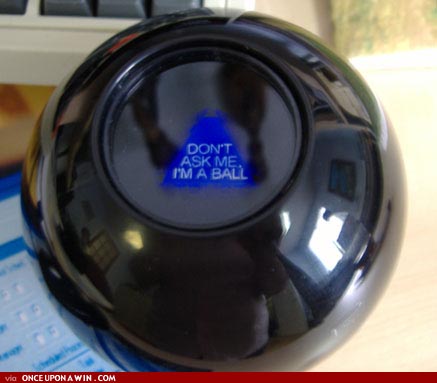
In our culture today, especially here in America, we're always told to "follow our hearts." I get the general point, and to some extent, I agree. Our hearts are the source of our desires and dreams, and without our hearts to light a fire under our logic-driven minds, we would be stuck inside our boxes of complacency and mediocrity. However, our hearts are also the source of all of our emotions. Depending on the person (and gender, but we won't go there today), your emotions can be very random and change about as often as the weather. One moment you feel this way; the next moment, you feel another way. Is it any wonder that Jeremiah 17:9 describes the heart as being "deceitful above all things" and not able to be understood? During a conversation about this topic, I half-joked that being lead by your heart is like being lead by a magic 8-ball. Our emotions can be very random, and the heart is the source of said randomness, so what would happen when we allow ourselves to be completely driven by our hearts? Chaos.


One negative side-effect of your heart being such a random thing is that your emotions are equally as random. And when we allow our emotions to run rampant, we end up a proverbial "hot mess." Thus, we have to learn to control our emotions. What? You don't think it's possible? I know it can seem that way. It's not an easy thing to do and takes much practice and discipline, but it can be done. By no means have I mastered this, but I learned how from one of my favorite books, "Mighty Man of God", written by Sam Laing. In chapter 9, which is about discipline, Sam says this about having disciplined emotions:

"Many of us, though, are accustomed to giving in to our moods... We act as if our mood is the ultimate reality--that because we feel a certain way, then that is how we must remain until it passes...

Moods are a product of thought, and what we think about is a choice we make.

The solution is simple: to change our mood, we must change the thoughts and attitudes that produced the feelings in the first place."


In short, we can control our emotions by controlling our thoughts. Of course, we can't always control what we initially think about. We all have thoughts and emotions that take us by surprise, popping up in our minds when we least want or expect them to. We can, however, control whether or not we continue to think about those thoughts. As 2 Corinthians 10:5 says, we have to take every thought captive. As one speaker during Church once said, you have to "take the needle off the record," so to speak. As long as you allow your self to continue to think about what caused you to feel whatever negative emotion you're experiencing, that feeling will continue until you choose to stop. We don't often like to take such responsibility for how we feel, but we ultimately choose to feel however we feel about something.

I know some of you may be thinking, "Yeah, I can control my own thoughts, but what about what goes on around me? I can't control the actions of others, and sometimes it's what others do around me or to me that gets me heated." True, the only person you can control is you. You have no power over whether or not your co-worker is going to be a jerk to you today, but you can control whether you continue to think about what he or she does. You have to choose whether or not you let your surroundings affect you. You have to be what I refer to as "warm-blooded" emotionally. Think about a cold-blooded animal vs a warm-blooded animal. A cold-blooded animal cannot regulate its own body temperature. It is at the mercy of whatever its surrounding temperature is. This forces it to sit out in the sun or find shade as needed; otherwise, it dies. A warm-blooded animal is, for the most part, able to regulate its own body temperature. It takes extreme temperatures to affect a warm-blooded animal. In relation to our emotions, we can either choose to be cold-blooded emotionally, allowing ourselves to be swayed emotionally by whatever may come our way, or we can be warm-blooded emotionally, keeping our thoughts in check, which will ultimately keep our emotions from controlling us.

So, ask yourself: Are you going to be cold-blooded, or warm-blooded?

Friday, February 25, 2011

Just NASTY

- I consider myself a hygienic person. I shower daily; more than once if necessary. I wash my hair so much that my mom once accused me of being white (hey, I had a bad experience with dandruff once; used too much Murray's wave grease). I lotion regularly and can't stand being ashy. I use cologne (Burberry Brit, Bvlgari & Jovan N-R-G are my weapons of choice) and get often get compliments on it. I brush my teeth regularly and keep a pack of Altoids in my pocket at all times. I say all this to say that I'm pretty confident that I don't have a B.O. problem. However, every once in a while, something happens that makes me second-guess myself.

You see, there's this guy that works the night shift at my job. For some strange reason, despite the fact that I've sat at multiple locations throughout my time here, this dude manages to end up sitting at my desk overnight. This, in and of itself, I do not have a problem with. However, dude apparently does not have a good sense of personal hygiene. I shudder to even wonder how often (or not) he takes a shower. When I come in to work, I sit down and clock in to my computer and phone as normal. I never notice it right away. Eventually, I move around in my seat, and that's when it hits. That repulsive, musty man-funk that has become deep-seated in my chair from him sitting in it for a whole 8-hour shift, wafts up to my nose. Somehow, I'm able to keep from gagging aloud. Sometimes, I'm able to switch my seat w/ another unused one, but when I'm not, I spend the day feeling all self-conscious about how I smell. I'm like, "Ok... I did take a shower this morning, right? And I just washed these jeans... That can't be me, can it?"

Until something is done about said person and his hygiene (or lack thereof), I've decided to take preventative measures. I keep a bottle of FeBreeze in my work locker. Before I sit down, I smell the back-rest of my chair (ain't no way I'm putting my nose in the actual seat. Naw, shawty... cain't e'en do it). If I get any hint of mustiness, I still switch my seat, but before I do, I walk back to my locker to retrieve my fresh-gun and proceed to hose it down. Being the considerate guy that I am, I would hate to set up the next poor soul who happens to get that chair to suffer the same fate.

'Cause that's JUST NASTY.

- Speaking of my place of work, I've noticed that, almost without exception, everyone at my job is either a computer geek/nerd, a chain smoker, or both. Now, I'm used to being around smokers. My dad has smoked for as long as I've known him, but he's never just wreaked of smoke. Mostly because he drenches himself in cologne (I once let him borrow a bottle of polo, only to have it be all but depleted within a few short weeks), but also because he has the decency to roll down the window when smoking in the car. The dudes I work w/ are a different story. I get within 4 feet of some of them and it's all too obvious that they smoke like a fire. However, that isn't the worst part, by any means. ***WARNING: TMI COMING UP. There, I warned you ;-)*** We all know how bad it is to walk into a public restroom just after someone bombed it. This horrific smell is amplified when said bomber is a heavy smoker. Apparently, all that nicotine and methane (or whatever the heck else is in cigarettes... I really don't care to know) permeates through that person's body and contributes to the already disgusting smell. I hope none of you have to witness that smell. My words can never truly describe it.

It... It's... JUST NASTY.

(I've been trying to write this next one since '06. For some strange reason, my laptop would always freeze or blue-screen me whenever I was about to finish. Here goes...)

- I still remember the first time that I visited the men's restroom on the lower level of Lenox Mall. I walked in and noticed what I can best describe as a fork in the road. Two separate, long rooms separated by a wall in the middle. To the left are all the urinals. So, I proceeded to take care of my business. As I walked out, I expected to pass the sinks so that I could wash my hands like any other hygienically inclined person would do. Unfortunately, there were no sinks on my way out. I could have very easily walked out of there w/ out seeing a sink. I decided not to give up, so I searched the bathroom for the sinks (one would think you wouldn't have to search for a sink in a restroom). I found that the sinks are on the other side of the bathroom where the stalls are. Ok, so you're probably thinking to yourself, "Big deal. So what, you have to look for the sinks." I would wholeheartedly agree with you on that, but consider this. I would like to think that most people would put forth that type of effort to wash their hands, even if the sinks weren't conveniently placed on the way out of the restroom. However, I can imagine that there are probably some people who only wash their hands because they see a sink on the way out; people who wouldn't give a second thought to it otherwise. Add that to the amount of people who probably don't wash their hands anyway, and you have a disturbing number of guys who leave the bathroom at Lenox mall without washing their hands.

And what's the first thing you see upon leaving said bathroom? The food court.

Now that's JUST NASTY.

Monday, January 24, 2011

My First Photoshoot

Since salsa doesn't bring in enough dinero to pay the bills, I refrain from calling myself a "professional" instructor. I half-jokingly refer to myself as a "semi-professional" instructor. Still, professional or not, one can only benefit from looking the part. Recently, I was fortunate enough to have a student who is also a graphic designer and photographer. Far be it from me not to realize and take advantage of an opportunity when I see it, I was able to have a logo made and my first photo shoot as well. Below is a slideshow of the beautiful artwork (I consider photography artwork as well) of my wonderful student and photographer, Angela C. Smith. The beautiful young lady in my pics with me is my lovely dance partner, Sarita Atiles.